Home / The Centrepiece / Contemplation
I · The Centrepiece
Contemplation
Drawing Room / Living Room / Dining Area / Bed Room / Staircase
By day: metalwork and crystal, holding the ceiling.
By night: the reason the room needs nothing else.
Rs. 130,832Tax included · free shipping across India
Scroll · the day passes through this room ↓
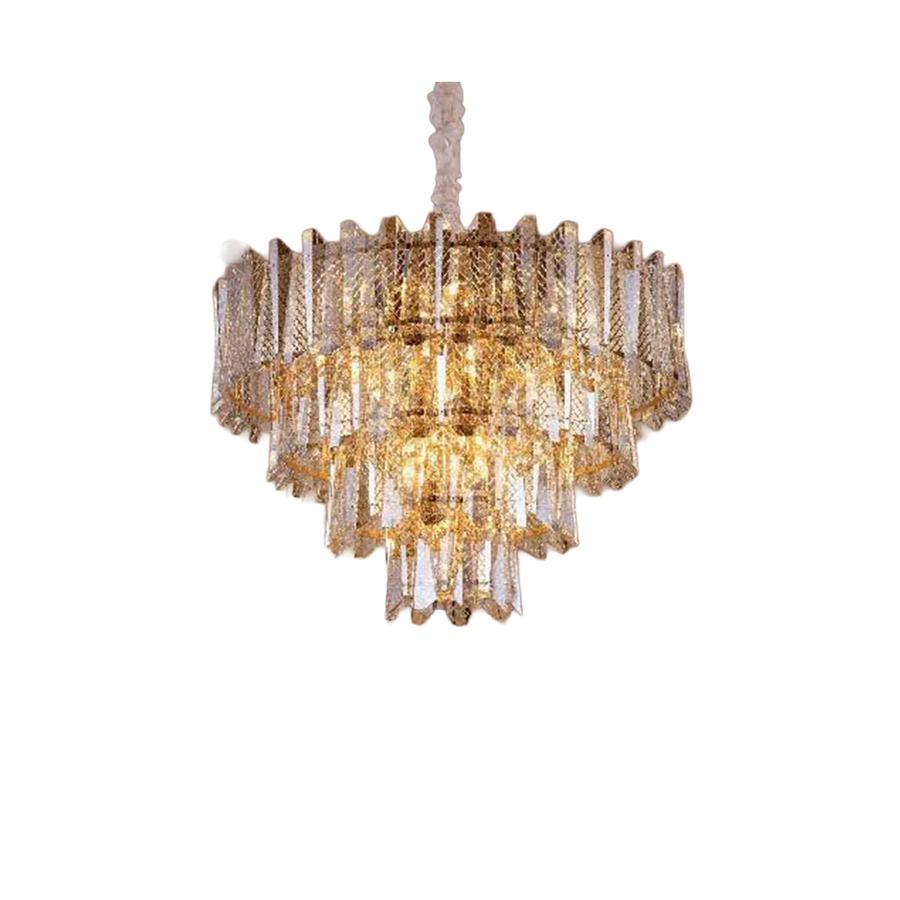

MaterialDesigner Cut Glass + MetalBulbsOnly E-14 Bulb Holder is AvailableDimensionD800 , D600 , D500DispatchWithin 3 working days, from Jaipur
The sheet
Everything on paper.
Specification, delivery and care
one card, nothing else.
BrandLumeilQuality-checked in Jaipur before dispatch
Dimension (In mm)D800 , D600 , D500
MaterialDesigner Cut Glass + Metal
Body ColorAmber Glass + Golden frame
Light ColorWarm White / White Bulb (Bought separately as you Choose)
StyleChandelier
Light Bulb & WattageOnly E-14 Bulb Holder is Available
PaymentCards · UPI · Net bankingOr pay on delivery: a 10–20% advance, the balance in cash
InstallationFree over ₹4 lakhWe send a fitter. Below that, we guide your electrician by phone
Returns7-day windowDamaged or incorrect pieces exchanged or refunded in full
Care & maintenance
Before you decide
Five questions, answered plainly.
For everything else, our team picks up till six
+91 97724 56345
What ceiling height works best for Contemplation?Versatile across residential ceiling heights 9 to 12 feet works well for bedrooms, drawing rooms, and dining areas. The faceted glass panels benefit from moderate height to create their shifting refraction patterns without being too distant from viewers. For staircases with greater height, Contemplation maintains visual interest because the cut glass catches light differently at each vertical position.
Is designer cut glass more fragile than standard glass panels?The faceting process actually increases structural integrity. Cut glass develops internal stress patterns during heating and cutting that, when properly executed, make panels more resistant to impact than smooth glass of equivalent thickness. The glass chandelier elements are tempered after cutting for additional durability. For bedrooms and dining areas, Contemplation handles normal residential conditions reliably the craft techniques enhance rather than compromise structural performance.
How does amber-toned glass affect room color and mood compared to clear glass? Amber glass filters out cooler blue wavelengths while emphasizing warmer reds and golds, creating psychological warmth that clear glass cannot achieve. In bedrooms and drawing rooms, this produces calming atmosphere conducive to relaxation and contemplation. The metal chandelier framework in complementary warm finishes (bronze, brass, aged gold) reinforces the amber tones. The effect is subconsciously warming rooms feel 2-3 degrees warmer than actual temperature due to color psychology.
Does the faceted cut glass provide adequate light output, or do the cuts reduce brightness?The facets actually improve light distribution. Each angled surface redirects light in multiple directions, creating comprehensive room coverage from single source. In bedrooms and dining areas, Contemplation provides sufficient ambient lighting as primary overhead fixture while the scattered refraction prevents harsh glare. The cut glass transforms point-source brightness into diffused illumination that fills spaces more evenly than smooth panels.
Did you know that the combination of amber glass and a golden frame creates a stunning visual contrast?Cut glass faceting glass surfaces to create prismatic refraction originated in 17th-century Bohemia, where craftsmen discovered that angled cuts dramatically increased light scatter compared to smooth surfaces. The technique requires heating glass to precise temperatures (around 1000°C) before cutting, as cold glass shatters under tool pressure. Each facet must be angled correctly to refract light toward viewers rather than away. Contemplation's designer cut glass carries this 400-year tradition forward: each panel is individually faceted by trained artisans, ensuring the light-scattering properties that machine-cut glass cannot replicate. It's medieval optical craft meeting contemporary design proving that some manufacturing techniques resist automation because human judgment still produces superior results.
Contemplation, at length
The full story, for the detail readers.
No. 1 · The materialDesigner Cut Glass + MetalChecked in Jaipur before dispatch.
No. 2 · The lightWarm White / White Bulb (Bought separately as you Choose)Only E-14 Bulb Holder is Available
No. 3 · The dropD800 , D600 , D500Measured in millimetres. Our team will send drawings for a difficult ceiling.
No. 4 · The finishAmber Glass + Golden frame
A statement piece for contemporary and traditional rooms alike, built from materials chosen to last.
Some rooms ask you to pause. Contemplation creates that invitation through designer cut glass in amber tones paired with metal framework that honors craftsmanship over mass production. Each glass panel is deliberately cut to refract light through multiple facets, creating complexity that rewards extended viewing. The amber glass filters light into warm golden tones even when unlit colored glass catches and holds ambient daylight differently than clear panels. Metal provides structural paths between glass elements, creating visual rhythm through material alternation. Switch on interior lighting and the cut glass transforms into layered amber brilliance, filling bedrooms and drawing rooms with warm refracted patterns that shift as you move through space. For staircases and dining areas where atmosphere matters as much as illumination, Contemplation proves luxury isn't about scale it's about deliberate beauty executed with patient craft.